


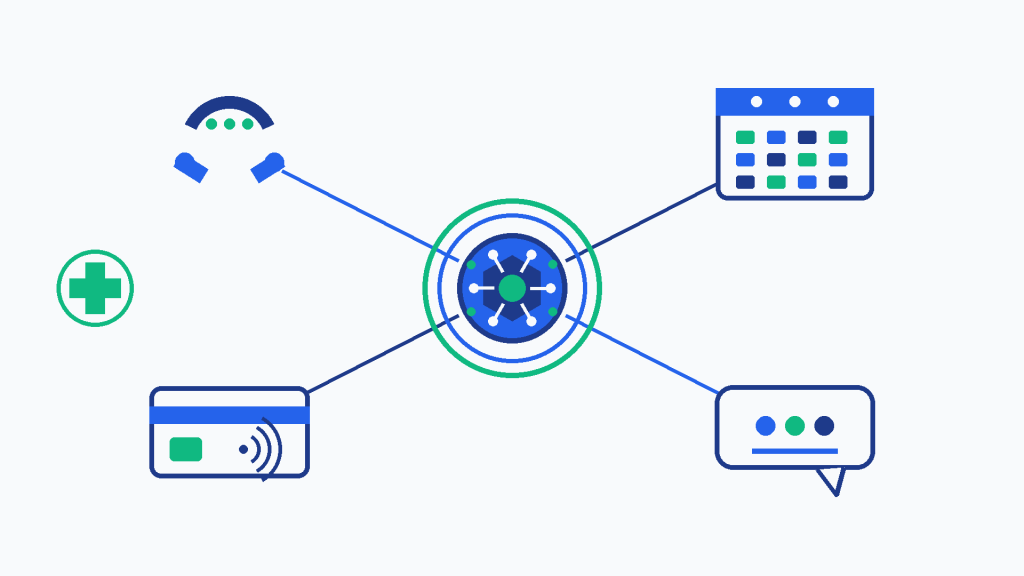
Ask most people what “AI in healthcare” means and they picture a computer reading a scan or a chatbot diagnosing a rash. That is the story the headlines tell. It is also the slowest, most regulated, highest-stakes corner of the field — and it is not where AI is quietly changing how medicine actually gets delivered today.
I build AI for healthcare practices. The work that moves the needle right now has almost nothing to do with diagnosis. It is the operational layer — the phones, the scheduling, the follow-ups, the payments, the administrative weight that sits between a patient and their care. That is where AI is already paying for itself, and it is where I have spent my time.
This is my view of what works, what does not, and what separates healthcare AI that survives contact with a real practice from the demos that fall apart the moment a patient goes off-script.
The hype is aimed at the wrong layer
Diagnostic AI is real and important. I am not dismissing it — there is genuine, valuable work in medical imaging and clinical decision support, and it deserves the attention it gets. But it is a different problem with a different timeline: clinical validation, regulatory pathways, liability, and deep integration into clinical workflow. It is not my focus.
Meanwhile, the average practice is drowning in operations. Calls go unanswered. Patients wait on hold or land in voicemail. Schedules sit half-empty while a waitlist goes untouched. Recalls never go out. The front desk is overwhelmed, and every missed call is a patient who did not get care and revenue that never materialized.
That gap is an AI problem you can solve today — no clinical risk, immediate return, and a patient experience that is genuinely better. I have written before about how a single overwhelmed front desk quietly costs a practice thousands of dollars a day; that is the problem worth pointing AI at first.
Why operations is where AI pays off first
A practice does not need AI to be superhuman here. It needs it to be reliably good at the things humans are bad at doing 24/7 at scale: answering every call, in every language, at every hour; turning a messy phone conversation into a booked appointment or a clean handoff; following up without ever forgetting.
The economics are obvious once you look — missed calls, no-shows, unfilled chairs, and the staff burnout that comes from doing repetitive work under constant interruption. This is the hidden productivity crisis inside practices that already own world-class clinical technology. The clinical side is modern; the operational side is still running on hold music.
The principles that separate what works from what demos
It has to integrate, not sit beside the practice
An assistant that takes a message but cannot book the appointment, cannot collect the payment, and cannot write to the system the office actually runs on is a fancy answering machine. Real value starts when the AI can act inside the practice’s systems — scheduling, payments, patient records — not adjacent to them.
Two kinds of integration matter. Open integration — APIs and webhooks so a practice can wire the assistant into whatever tools it already uses. And deep, native integration into the systems that run the office: the practice management system, payment processing, and the channels new patients arrive through, including the marketing sources that bring them in. One caveat I hold firmly: integration is for operational actions — booking, confirming, collecting a copay — never clinical ones.
Meet patients where they are
Good operational AI meets patients on three axes: the language they speak, the medium they are comfortable with, and the time that works for them.
Language: a patient who speaks Spanish, Farsi, or Mandarin should not receive worse service because the front desk does not. Channel: some people call, some text, some use web chat, some email — the assistant should be one brain across all of them, not four disconnected bots that forget each other. Time: care needs do not keep office hours, and a practice that can only respond from nine to five is missing patients every evening and weekend.
Keep clinical judgment with the clinicians
Here is the line I will not cross: AI handles operations and communication; clinicians make clinical decisions. The assistant books the visit, gathers the right information, and routes an urgent caller to a human immediately — it does not triage symptoms, give medical advice, or stand in for a provider’s judgment. That boundary is not a limitation. It is exactly what makes a system safe to deploy and easy to trust.
Reliability is the whole game
This is the part nobody puts on a slide. A demo that works once is easy. An assistant that handles thousands of real conversations — frustrated patients, bad phone connections, names it cannot spell, people who change their mind halfway through — without ever dropping a critical step is genuinely hard. And most of what makes it hard is not in your code. It is in the model.
A few of the walls you hit, the moment you try to make this real:
- The model goes silent after it looks something up. In a chat window that is invisible. On a phone call it is dead air — and dead air on a medical call reads as a dropped call to a worried patient.
- It rounds. Ask for the only open slot and it will cheerfully offer “two o’clock” when the time is 2:20. A human would never round someone into the wrong appointment. A model treats a number as a word to paraphrase unless you force it not to.
- It declares victory early. Tell it to collect a date of birth and it will sometimes sail right past with half the information and a confident summary. Guaranteeing it actually collected — and validated — what the office needs is its own problem.
- It mishears the things that matter most. Unusual names and numbers are exactly where speech recognition is weakest, and a misheard name is not cosmetic — it is the difference between the right chart and a stranger’s.
- It invents reassurance. Left unconstrained, it will tell a patient “a nurse will call you back within the hour” — a promise the office never authorized. Trust evaporates the first time that call does not come.
The instinct is to script your way around all of this. Resist it. Scripts are not how good human operators work, and they shatter the instant a real conversation leaves the expected path. The harder, better goal is an assistant that converses naturally and is still guaranteed never to miss what matters — confirming who it is talking to, collecting the required information, taking the correct action, escalating a true emergency. Getting a model to sound human is, at this point, solved. Getting it reliable enough that a practice can hand it the phone is not. That gap — natural but dependable — is the real engineering challenge in this field.

If I had the ear of the frontier labs — xAI, OpenAI, Anthropic — this is the short list I would hand them, because every item is a guardrail builders like me are forced to hand-roll today: continue the turn automatically after a tool call instead of going silent; render structured values like times and dates faithfully instead of paraphrasing them; let me declare required information the model must collect and validate before it ends a call; get proper nouns and numbers right in speech, with confidence scores; and give me an enforceable instruction hierarchy with a non-negotiable safety floor the model cannot be talked out of. Whoever closes those gaps wins the people building real applied AI, not just demos.
Compliance and honesty are the foundation, not the footnote
Healthcare AI touches protected health information from the first minute. Business Associate Agreements, encryption, audit trails, minimum-necessary data, and patient deletion are not features you bolt on later — they are the floor you build on.
Just as important is capability honesty. The assistant should disclose that it is an AI. It should never fabricate. And it should never promise a patient something the practice did not authorize. An assistant that overpromises erodes the exact trust that makes the whole thing work.
What this looks like in practice
I put these principles into Viva, an AI front office for dental practices. It answers a practice’s calls, texts, web chats, and emails around the clock, in more than 100 languages, switching language mid-conversation when a patient does. It books appointments directly into the practice’s scheduling system, collects payments, sends confirmations and reminders, and runs recall and reactivation campaigns to fill the schedule. When a caller is urgent or upset, it hands them to a human.
What it never does is make a clinical decision. It handles the operations around care so the team can focus on care itself — which is the entire point.
In one practice’s first 30 days, that looked like zero missed calls, more than 30 hours of staff time saved each month, patient-satisfaction scores above 90%, and tens of thousands of dollars in production it helped generate. Dentistry is a particularly good proving ground — it carries all the operational pain of healthcare with a faster feedback loop — but the same principles carry across medical front offices. It is why I think AI is doing more to expand access and prevention than most people realize, why the practice of the near future looks less like science fiction and more like an office where the busywork simply disappeared, and how the same operational data, used well, feeds back into smarter treatment planning.
Where this actually goes
The near-term future of AI in healthcare is not a robot doctor. It is the quiet disappearance of operational friction that has been accepted for decades as the cost of running a practice: the phone that always gets answered, in the patient’s language, at any hour; the schedule that fills itself; the follow-up that always happens; the staff freed from busywork to do the human parts of the job.
Diagnostic AI will keep advancing, and it should. But the version of healthcare AI that is already here — and already worth paying for — is operational. That is the part I build, and it is the part I would tell any practice to pay attention to first.
Frequently asked questions
What is AI in healthcare actually used for today?
The most mature, lowest-risk uses are operational: answering calls, scheduling, patient communication across languages and channels, reminders, follow-ups, and payments. Diagnostic and imaging AI is advancing but faces longer clinical and regulatory timelines, so its day-to-day impact on most practices is still limited.
Will AI replace doctors or front-desk staff?
No. The effective model keeps clinical judgment with providers and uses AI to remove repetitive operational work — answering every call, booking, following up — so staff can spend their time on patients instead of busywork.
Is AI in healthcare safe and HIPAA compliant?
It can be, when privacy is built in from the start: Business Associate Agreements, encryption, audit trails, minimum-necessary data handling, and a hard rule that the assistant discloses itself, never fabricates, and escalates emergencies to a human.