


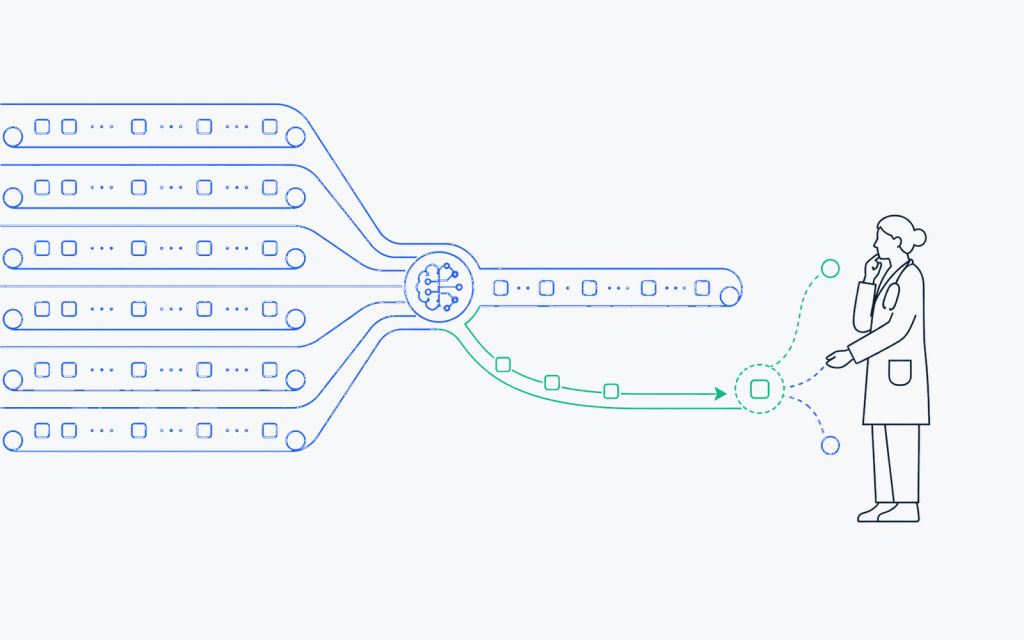
There’s a question that sits underneath every conversation I have with a practice owner about AI. Sometimes they ask it out loud; usually they don’t. It’s this: if AI ends up doing more and more of the work, what’s left for my people?
It’s the right question, and I think most of the industry answers it badly — either with a shrug (“humans will do higher-value work,” whatever that means) or with a quiet threat (“fewer humans”). Neither is useful, and neither is true to what actually happens when you deploy these systems in a real practice.
I’ve argued that healthcare becomes AI-native from the operations up, and I’ve laid out the stages an organization climbs to get there. Stage 4 — AI-Native — has a two-word definition I’ve used in passing: humans provide judgment. This article is about what that actually means, because it turns out to be the principle that decides whether an AI-native operation is safe, trusted, and legal — or a liability waiting to happen.
The principle is: Humans Decide. AI Operates. And the reason it works is not sentiment. It’s structure.
Execution and judgment are different kinds of work
Start by separating two things the industry usually blurs together.
Execution is work that is high-volume, repeatable, and checkable. Answering the phone. Booking the appointment. Sending the reminder. Capturing the intake. Collecting the copay. Following up on the no-show. Doing it in the patient’s language, at 2 a.m., for the fortieth caller that hour. This work has a right answer you can verify against the record, and its value comes from doing it consistently at a scale no human team can sustain.
Judgment is work that is rare, ambiguous, and consequential. Whether a chest pain is an emergency. Whether an upset caller needs a person, now. Whether an unusual request is an exception worth making. Whether this is the moment to stop following the script and just listen. This work has no clean right answer, changes with context, and its value comes from a human bringing experience and empathy to a situation that doesn’t fit a pattern.
Here’s the whole argument in one line: execution scales; judgment doesn’t. And a system that confuses the two — that either makes humans do the execution or lets AI make the judgment — is badly designed in both directions.

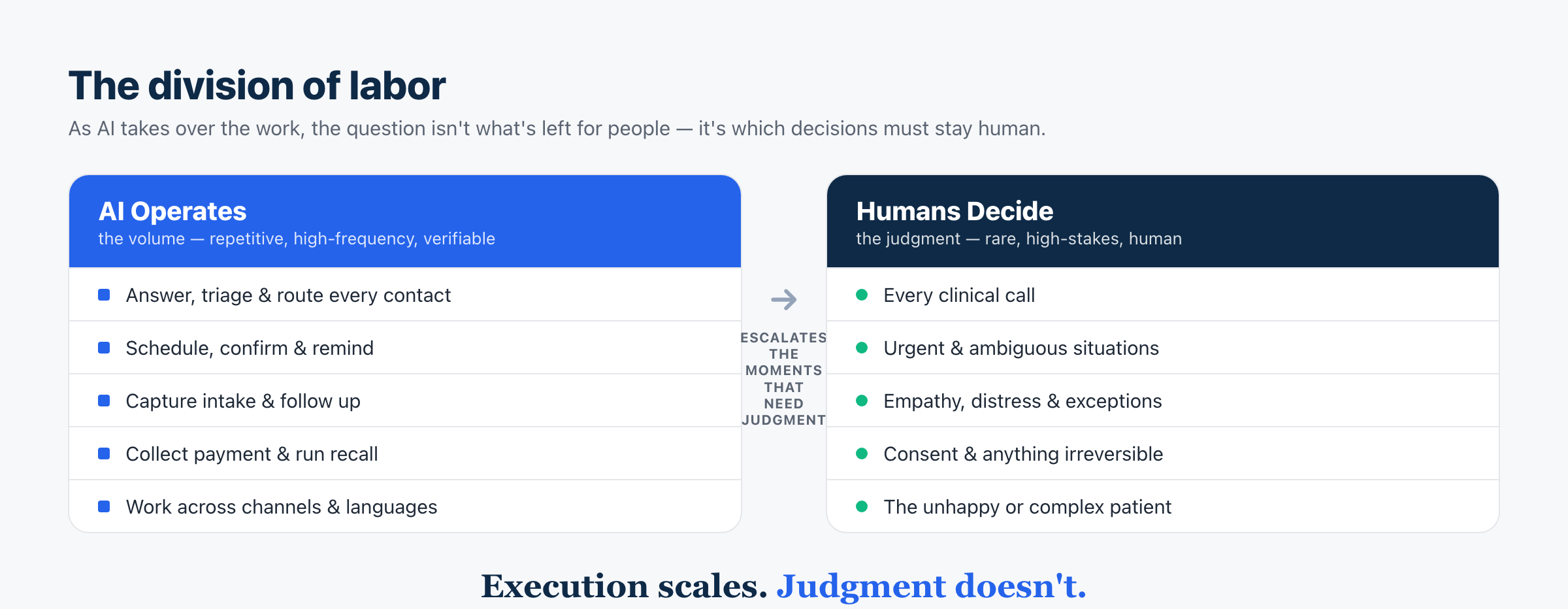
Look at the split. The left column is where AI belongs: the volume. The right column is where humans belong: the calls that carry weight. AI-native isn’t the left column swallowing the right. It’s drawing the line between them on purpose, and building the machinery that moves work across it.
“What’s left for people” is the wrong question
Now we can answer the practice owner’s question properly. The fear behind it is that AI is climbing up — taking the easy work today, the harder work tomorrow, until it reaches the judgment and there’s nothing left. But that’s not the shape of it. AI isn’t climbing toward judgment. It’s clearing everything that isn’t judgment out of the way.
What’s left for people isn’t a shrinking residue. It’s the concentrated core: the moments that actually require a person. Today a great front-desk person spends most of their day on execution — phone tag, data entry, chasing — and gets to the human moments in whatever time is left. Flip that. Let AI carry the execution, and the person’s whole day becomes the moments that need them. That is not less valuable work. It’s the most valuable work, finally undiluted.
The role of AI is not to replace judgment. It’s to reserve judgment for the moments that require it. That’s a better deal for the practice, the staff, and the patient — and it only works if the architecture makes the handoff clean.
The handoff is the product
This is the part builders get wrong most often, and it’s the heart of the principle.
An AI operation is not judged by how much it handles. It’s judged by how well it hands off what it shouldn’t. When a caller becomes urgent, or angry, or clinical, or simply lands in a situation the system wasn’t built for, what happens next is the product. Does it recognize the moment? Does it transfer to a real person with the context already in hand, or dump a confused patient into a cold queue to start over? Does it escalate to the right person, and document why?
Most “AI receptionists” treat the handoff as a failure state — the thing that happens when the bot gives up. That’s exactly backwards. In healthcare, the handoff is a designed feature, the most important one, because it’s the seam where trust and liability live. A system that never escalates is not impressive; it’s dangerous. A system that escalates gracefully is one a practice can actually hand the phone to.
So when I say humans decide, I don’t mean a human rubber-stamps the AI’s output. I mean the architecture is built to detect the moments that need a person and route them there cleanly — with escalation treated as a first-class path, not a fallback.
The regulators arrived at the same line
Here’s what convinced me this isn’t just good product design but a durable principle: the law is converging on exactly the same boundary, from an entirely different direction.
CMS’s rules for Medicare Advantage state that an algorithm can inform a coverage decision but cannot be the sole basis for denying care. California’s SB 1120 — the “Physicians Make Decisions Act” — requires that medical-necessity decisions be made by a licensed human, not supplanted by AI. And the lawsuits working through the courts over algorithmic claim denials all circle the same fault line: an algorithm may assist, but a human must make the call.
Regulators didn’t read my framework. They arrived at “Humans Decide. AI Operates.” because it’s where the logic lands when the stakes are real. Which means a practice that designs to this line isn’t just being careful — it’s building the way the regulatory environment is going to require anyway. Designing for judgment-stays-human is how you stay both safe and ahead.
What this means if you’re building or buying
If you’re building, the discipline is to make the boundary explicit in the architecture, not implicit in a prompt. Define which actions the system may take on its own, which require a human, and what triggers an escalation — and build the escalation path to carry full context to the right person. The hard engineering isn’t making the model sound helpful. It’s making it reliably recognize the edge of its own competence and hand off before it crosses it.
If you’re buying, stop asking “how much can it handle?” and start asking “what does it do with the things it shouldn’t?” Ask the vendor to walk you through an urgent call, an angry patient, a clinical question, an ambiguous request. If the answer is that the AI handles everything, run. If the answer is a clear, designed escalation path with context preserved, you’re looking at something built by people who understand healthcare.
The bottom line
The anxiety that AI will hollow out the human role in healthcare gets the direction exactly wrong. Done well, AI doesn’t take the meaningful work — it takes everything around the meaningful work, so the people are freed to do the part only people can.
That’s the principle at the center of an AI-native operation: let the machine do what scales, and reserve the human for what doesn’t. Execution scales. Judgment doesn’t. The organizations that internalize that — and build the clean handoff between the two — are the ones that will be trusted to run AI at the front line of care.
Humans Decide. AI Operates. Get that boundary right, and everything else in the framework has somewhere safe to stand.
Frequently asked questions
What does “Humans Decide. AI Operates.” mean?
It’s the principle that divides the work in an AI-native healthcare operation by kind: AI handles execution — the high-volume, repeatable, verifiable work like answering, scheduling, reminding, and following up — while humans handle judgment — the rare, ambiguous, high-stakes decisions like clinical calls, urgent situations, exceptions, and consent. AI operates; humans decide.
Will AI replace front-desk and administrative staff?
It replaces the work, not the people — and specifically the execution work that already crowds out the human moments. Done well, it frees staff to spend their time on judgment, empathy, and the complex cases, which is both higher-value and harder to automate. The goal is to reserve people for the moments that require people, not to remove them.
Why is the human handoff so important?
Because in healthcare the handoff is where trust and liability live. An AI operation is judged less by how much it handles than by how well it escalates what it shouldn’t — recognizing an urgent, angry, or clinical moment and transferring it to the right person with full context. Escalation should be a designed, first-class feature, not a fallback for when the AI fails.
Isn’t “human-in-the-loop” enough?
Not if it means a human rubber-stamping AI output under time pressure — that’s theater. The principle here is stronger: the architecture must actively detect the decisions that require a human and route them there cleanly, with the human genuinely deciding rather than approving. The design determines whether the human is real or ceremonial.
How does this connect to regulation?
Regulators are converging on the same boundary independently. CMS says an algorithm can’t be the sole basis for a coverage denial; California’s SB 1120 requires a licensed human to make medical-necessity decisions; and algorithmic-denial litigation keeps landing on “an algorithm may assist, but a human must decide.” Designing to “Humans Decide. AI Operates.” keeps you both safe and ahead of where the rules are going.
Read next
- Why Healthcare Needs an AI Architecture (Not More AI Tools)
- The Healthcare AI Maturity Model
- The AI Front Office
- AI Voice Agent Architecture: What I Learned Building the Same Agent Three Times
- LLM-as-a-Judge for Voice Agents