


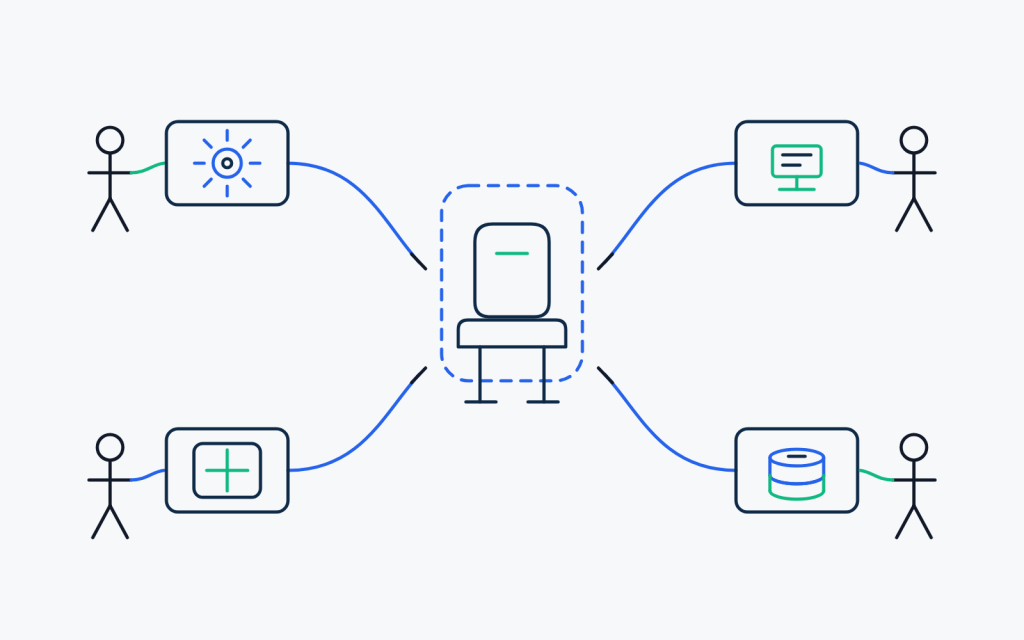
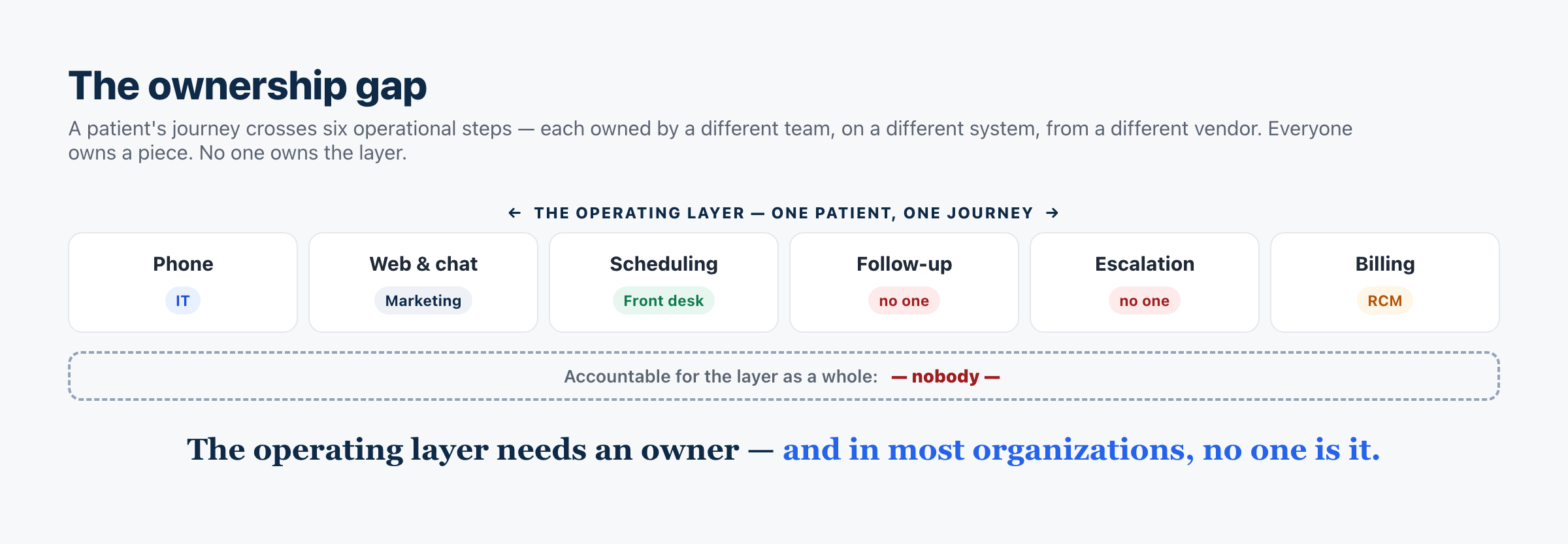
In my last piece I argued that healthcare organizations plateau at AI-Assisted for organizational reasons, not technological ones. Of the five, one kept surprising the executives I talked to — the fifth: no one owns the operating layer. The phone belongs to IT, scheduling to the front desk, the website to marketing, billing to the revenue-cycle team, and the shiny new AI tool to whoever ran the pilot. Every piece has an owner. The layer as a whole has none.
Once you see that gap, an obvious question follows, and it’s the one this piece is about: who should own it? Not who builds the AI — who owns the operation it’s supposed to transform.
It matters because the instinct, when an organization gets serious about AI, is to reach for technical talent: a data scientist, an ML engineer, a “Head of AI.” That instinct answers the wrong question. The scarce resource in healthcare AI isn’t the ability to build models — it’s ownership of the operating layer. And in most organizations, no one has it.
The bottleneck isn’t building AI
Start from what’s actually scarce. The models are a commodity and getting better every month; you can buy state-of-the-art capability through a vendor this afternoon. What you cannot buy is an organization redesigned to use it. That redesign — connecting the pieces, drawing the human decision boundary, sequencing the climb from one stage to the next — is the real work, and it is not a modeling problem. It’s an ownership problem.
So making model-building your first AI move is solving a bottleneck you don’t have. You’ll end up with people brilliant at building things, reporting into a structure where no one is accountable for the operation those things are supposed to transform — a very efficient way to add another tool to the pile and deepen the plateau.
The operating layer needs an owner — and in most organizations, no one is it.

Why none of your existing leaders can just absorb it
The natural objection is that this isn’t a new role — surely someone on the leadership team already owns it. Walk the org chart and you’ll find the answer is no, and why.
The CIO owns systems, security, and infrastructure — the rails, not the ride. IT can make the tools work; it is not chartered to redesign how a patient moves through the practice. The CMIO owns the clinical side — the exam room, not the front door. The COO owns everything, which in practice means the operating layer is one plate among fifty and never gets the sustained, dedicated attention a transformation requires. And the practice manager or front-office lead lives inside the operation but has neither the mandate nor the authority to renegotiate vendors, connect systems across departments, and make architectural decisions that cross IT, clinical, and finance.
That’s the trap. The operating layer sits in the seams between existing roles, so each leader reasonably tends their own slice and the whole falls through the cracks. You cannot fix a gap between owners by asking one of them to also own the gap in their spare time. It needs its own seat.
What the role actually owns
I’d resist inventing a title — titles date fast, principles don’t. The owner might be a new executive, an existing COO who takes it on deliberately, a practice owner wearing the hat explicitly, or a small transformation office. What matters is not the box on the org chart; it’s the mandate, and the mandate is specific. Whoever holds it owns the operating layer end to end: the patient’s journey across every channel, from first contact to booking to follow-up to payment, as one connected system rather than six departmental fragments.
Concretely, they own four decisions that are currently no one’s:
- Architecture — what connects to what, so the system acts instead of handing work back to humans to re-key.
- The human boundary — which decisions the AI makes and which escalate to a person, designed as a first-class path.
- Sequence — the order of the climb: what to modernize first, what to build on top of it, when.
- Outcomes — accountability for operational results (throughput, access, escalation quality, staff time returned), not for “number of AI projects launched.”
Notice what’s not on that list: building models, writing prompts, training algorithms. This is an operations role with architectural judgment, not a data-science role. The person should understand what AI can and can’t reliably do — but their job is designing the operation around it, not building it.
This applies at every scale
At a large health system this is a genuine executive hire with a team. At a two-provider practice it is almost certainly not a new full-time position — it’s a hat the owner or practice manager explicitly puts on, with the explicit authority to make it stick. The mistake at small scale isn’t failing to hire; it’s leaving the role unnamed, so it defaults to no one. The principle is the same regardless of size: the operating layer needs a single accountable owner, or the climb to AI-Native never gets driven.
I’d go further, though I’ll hold it loosely: I wouldn’t be surprised to see a role formalize in healthcare over the next several years the way the CISO did once security became existential, and the CDO did once data did — a dedicated owner of the AI-era operating layer. Whether it lands as a new title or an existing leader’s expanded remit matters less than the function existing at all. The organizations that assign it early, at whatever scale fits, will be the ones that get off the plateau. The ones waiting for the technology to mature are waiting for the wrong thing.
The bottom line
The plateau isn’t caused by a shortage of AI. It’s caused by a shortage of ownership — a layer that belongs to everyone and therefore to no one. You don’t close that gap by buying more capability. You close it by making it someone’s job.
So before the data scientist, before the next tool, before the pilot: name the owner. Give one person — or one clearly accountable structure — the operating layer, the mandate, and the outcomes. Whether that’s a new executive, an existing leader’s expanded remit, or a practice owner making it explicit will vary by organization; that it exists at all is what doesn’t. The organization that decides who owns the operation will out-transform the one still shopping for capability — because the scarce resource was never the intelligence. It was someone to own the operation the intelligence is supposed to transform.
Frequently asked questions
Who should own AI transformation in a healthcare organization?
Someone accountable for the operating layer — the patient’s journey across channels (contact, scheduling, intake, follow-up, escalation, payment) as one connected system. It can be a new executive, an existing COO who takes it on, a practice owner, or a transformation office; the form varies, the mandate doesn’t. The point is that today it’s usually owned by no one, which is why organizations plateau.
Isn’t the first move to hire technical AI talent?
That’s the common instinct, and it answers the wrong question. The bottleneck isn’t building models — those are a commodity you can buy through a vendor. The bottleneck is organizational: connecting the pieces, drawing the human decision boundary, and sequencing the climb. Adding a builder to an organization where no one owns the operation just adds another tool to the pile.
Can’t the CIO, COO, or practice manager own this?
Not effectively. The CIO owns systems (the rails, not the ride); the CMIO owns the clinical side (the exam room, not the front door); the COO owns everything, so the operating layer never gets dedicated attention; and the practice manager lacks the authority to renegotiate vendors and make cross-department architectural decisions. The operating layer sits in the seams between these roles, which is exactly why it needs its own seat.
What does the operating-layer owner actually do?
They own four decisions currently owned by no one: architecture (what connects to what), the human decision boundary (what AI does vs. what escalates), sequence (what to modernize in what order), and outcomes (throughput, access, escalation quality, staff time returned). It’s an operations role with architectural judgment — not a role that builds models.
Does a small practice need to hire someone new?
Usually not. At small scale it’s a hat the owner or practice manager explicitly wears, with explicit authority — not a new FTE. The failure mode isn’t under-hiring; it’s leaving the role unnamed so it defaults to no one. The operating layer needs a single accountable owner at any size.
Read next
- Why Organizations Plateau at AI-Assisted
- The Healthcare AI Maturity Model
- Why Healthcare Needs an AI Architecture (Not More AI Tools)
- Humans Decide. AI Operates.
- The AI Front Office