Search “AI in healthcare examples” and you get a list that is mostly things that are not running in your doctor’s office — and may not be for years. Cancer-detecting algorithms, drug discovery, robotic surgery. Impressive. Also not what happened when you called to book a cleaning last week and got voicemail.
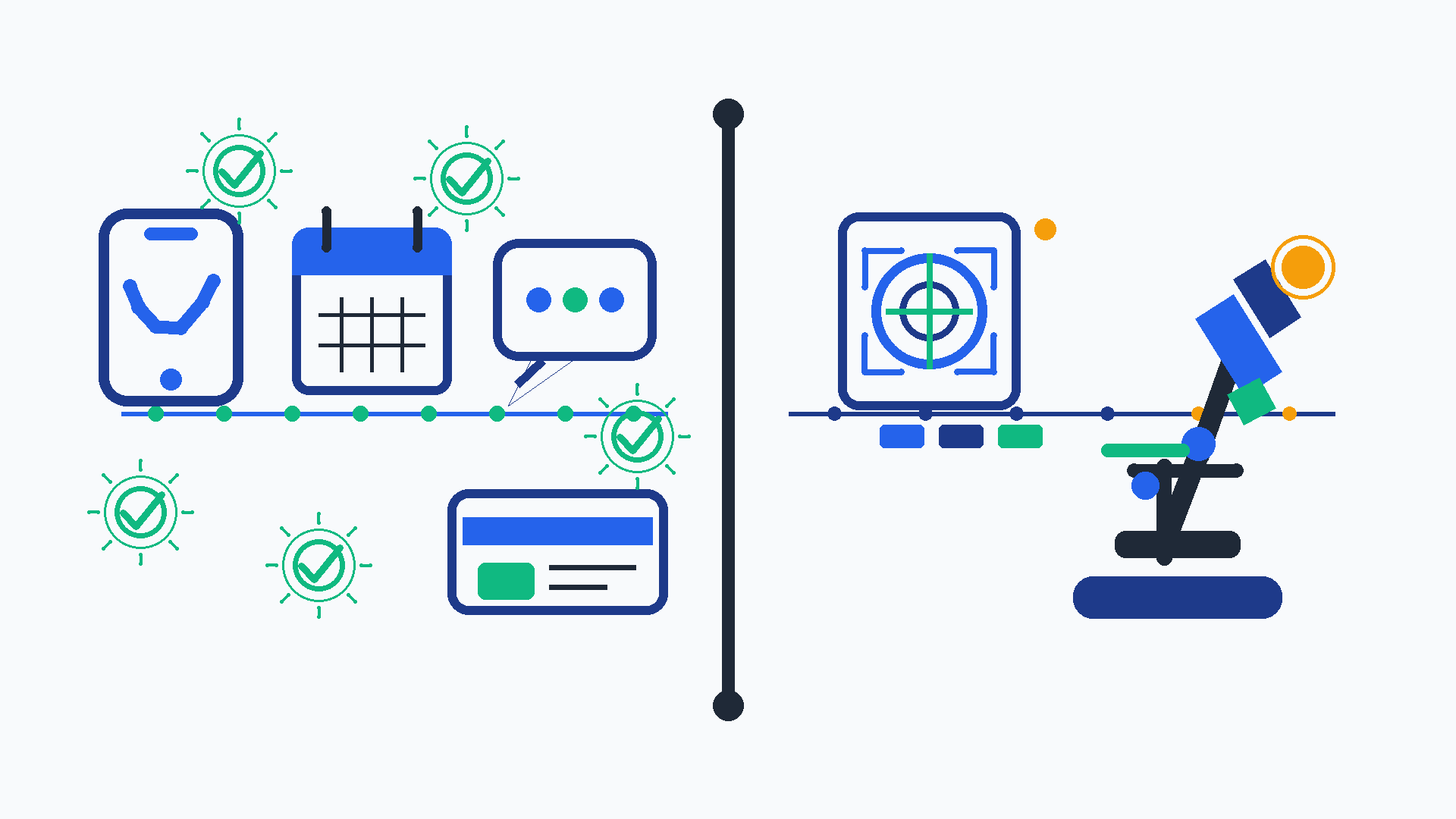
So here is the honest version, from someone who builds this for a living: what AI is actually doing in healthcare practices today, sorted from “working right now” to “be careful.” The pattern underneath it is simple, and I will give it away up front — AI wins where the task is repetitive, high-volume, and non-clinical, with a clean handoff to a human. It loses where the task is rare, high-stakes, or clinical.
What works right now
Every item here is operational, low clinical risk, and deployed in real practices today.
Answering every call, around the clock
The most boring use is the most valuable one. A practice’s phone is its front door, and most front doors are unattended half the day. AI answers every call — unlimited at once, no hold music, at 2 a.m. on a holiday — and turns it into a booked appointment or a structured handoff instead of a voicemail nobody returns. This single thing recovers more revenue than any clinical AI on the market, because the baseline it replaces is “missed.”
Scheduling that actually writes to the calendar
Capturing an appointment request is easy. Booking it — into the real scheduling system, with the right provider, the right service, and the right duration, then canceling and rescheduling on request — is where the value is. The difference between “took a message” and “filled the chair” is the difference between a toy and a tool.
Patient communication in any language
This is access, not a feature. A patient who speaks Spanish or Farsi should not get worse service because the office does not staff for it. AI that handles a conversation in 100+ languages — and switches mid-sentence when the patient does — removes a barrier that has quietly excluded people from care for decades. I have argued this is one of the most underrated ways AI expands access.
Recalls, reminders, and reactivation
Most practices are sitting on a list of patients who lapsed and never got a nudge. Outbound AI works that list — reminders, confirmations, “you are due” recalls — and fills tomorrow’s schedule from patients the office already has. It is the highest-return outbound work nobody has time to do by hand.
Collecting payments
Balances and copays collected over text and phone, tied to the visit, without a staff member chasing them. Operational, scriptable in the good sense, and a direct line to cash flow.
Intake and structured capture
Turning a rambling phone call into clean, structured data — who called, why, how urgent, what they need — so the human who picks it up makes a decision in ten seconds instead of decoding a voicemail. The value is not the transcript; it is the structure.
What is promising but not there yet for most practices
Real, advancing, worth watching — but not yet the thing most offices will feel this year.
- Ambient clinical documentation. AI that drafts the visit note from the conversation in the room. Genuinely useful and growing fast, but it sits at the clinical edge and adoption is still uneven.
- Diagnostic and imaging AI. The headline category. It is real and improving, but it lives behind regulatory clearance, clinical validation, and slow institutional adoption — which is exactly why the average practice does not touch it day to day.
What is overhyped — be careful
Two claims should make you suspicious, because they cross the line that keeps this safe:
- Anything that gives medical advice or triages symptoms on its own. The moment an AI tells a patient what their symptom means, you have left operations and entered clinical judgment — and that belongs to a provider.
- “Fully autonomous” anything inside a clinical system. Autonomy is great for booking an appointment. It is dangerous the second it can take an irreversible action a human did not review.
Why the working examples actually work
Go back to the pattern: the wins are repetitive, high-volume, non-clinical, with a clean handoff. The misses are rare, high-stakes, or clinical. That is not a coincidence — it is the map. If you want to know whether an “AI in healthcare” pitch is real, ask where on that map it sits.
And to be honest about the limits even on the wins: the things still holding operational AI back are not imagination, they are plumbing. Latency that creates dead air on a call. Uneven quality across languages. Speech recognition that mangles a patient’s name. Reliability that takes real engineering to guarantee. Those are model-layer gaps, and they are closing — which is exactly why this category is about to get a lot bigger.
The clearest example I can point to is the one I built. Viva runs the operational set above for dental practices — answering, scheduling, multilingual communication, recalls, payments — as one system, 24/7, while leaving every clinical decision to the team. In one practice’s first month that meant zero missed calls and tens of thousands of dollars in recovered production. None of it required the office to trust AI with anything clinical. That is the point.
Frequently asked questions
What are real examples of AI in healthcare today?
The deployed, low-risk examples are operational: 24/7 call answering, appointment scheduling, multilingual patient communication, reminders and recalls, payment collection, and structured intake. Diagnostic and documentation AI is advancing but less widely felt in everyday practice.
What is the most useful AI for a medical or dental practice right now?
Front-office automation — answering every call and turning it into a booked appointment or clean handoff — typically returns the most, because it replaces a baseline of missed calls and lost revenue with no clinical risk.