


The race in healthcare AI is being run on the wrong variable.
Almost everyone competes on capability — whose model is smartest, whose benchmark is highest, whose demo is most impressive. Vendors lead with it, buyers ask about it, and the whole conversation assumes that the most capable AI will win. In healthcare, it usually doesn’t. The most capable AI rarely wins. The one that ships does.
That’s the dimension this series hasn’t named yet, and it’s the one that decides who actually gets value from AI: execution. Not what a system can do in a controlled demo, but what it reliably does inside a messy, real operation, on an average Tuesday, at scale. The gap between those two things is enormous, and almost all of the value — and almost all of the failure — lives inside it.
Capability and deployment are different things
Capability is what an AI system can do in principle: the ceiling of its intelligence, the tasks it can perform when conditions are ideal. Deployment is what it actually does when wired into a real workflow, handling real patients, connected to real systems, with real staff depending on it.
These two things are not the same, and they are diverging. Capability is rising fast and, crucially, commoditizing — the frontier models are converging, and any organization can rent state-of-the-art capability through a vendor this afternoon. Deployment is not commoditizing at all. It stays hard, organization by organization, because it depends on everything around the model: integration, workflow design, the human decision boundary, staff trust, the handling of a thousand messy edge cases.

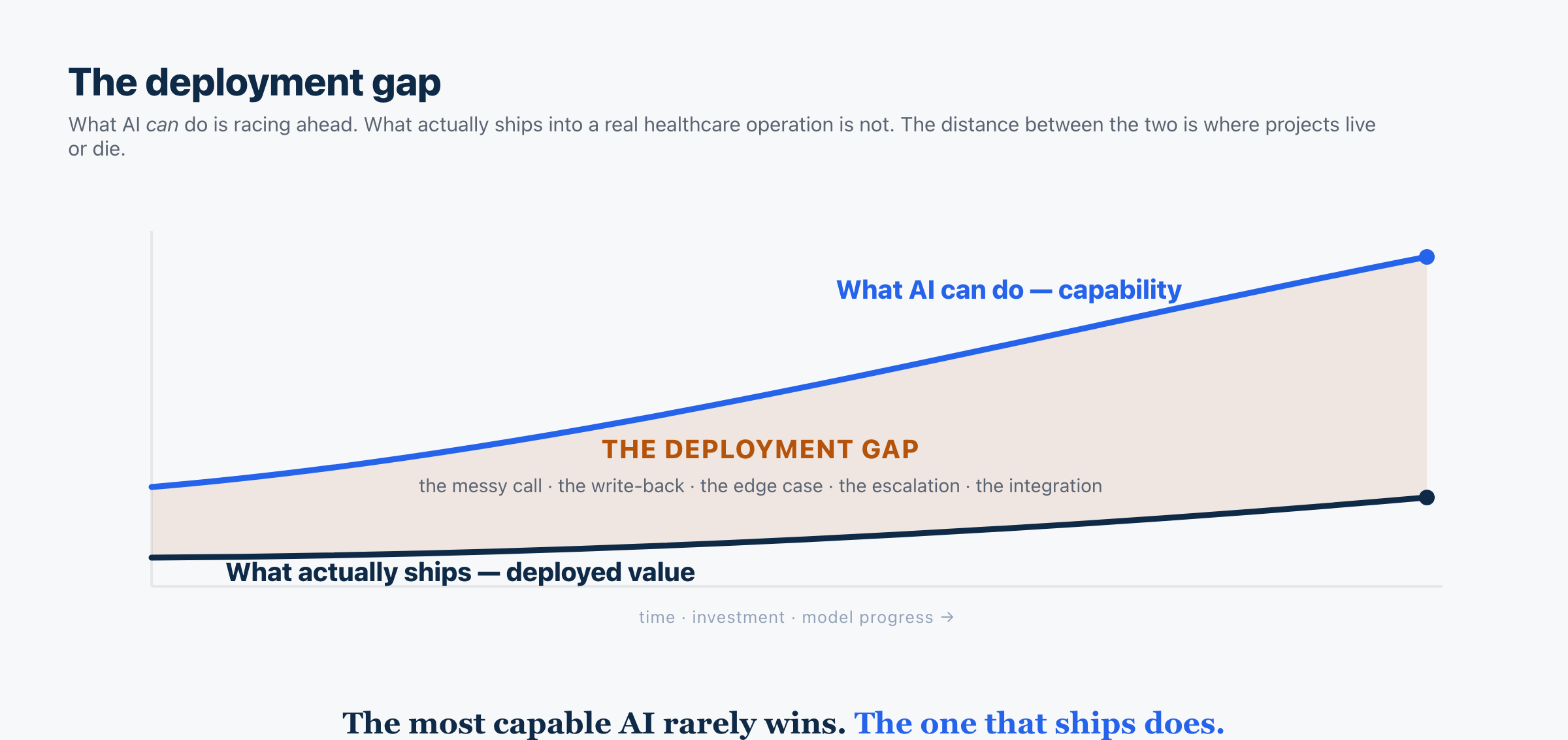
Look at the two lines. Capability climbs steeply and is available to everyone. Deployed value crawls. The shaded distance between them — the deployment gap — is where healthcare AI projects actually live or die. And notice what fills that gap: not smarter models. The messy call on a bad connection. The write-back into the practice management system. The edge case no demo covered. The escalation to a human. The integration that was supposed to take two weeks and took two quarters. None of those are capability problems. Every one is a deployment problem.
Why the gap is so wide in healthcare
Every industry has a demo-to-production gap. Healthcare’s is unusually brutal, for reasons that are structural, not incidental.
The inputs are messy in the specific ways that break AI. Patients call from noisy cars, interrupt mid-sentence, switch languages, give a wrong number and correct it, ask about a bill and a symptom in the same breath. A demo is a clean, cooperative, single-threaded conversation. Production is none of those things.
The outputs have to be exact. A consumer chatbot can round or paraphrase; a healthcare system cannot turn “2:20” into “around two” or confuse “fifteen” and “fifty.” The bar for a usable result is far higher than the bar for an impressive one.
The system has to act, not just talk. Answering a question is a capability. Writing the booking into the schedule, updating the record, triggering the reminder — that’s deployment, and it requires integration into systems that were never designed to be integrated.
And there’s a human on the other side who has to trust it. Staff route around tools they don’t trust, and they only trust a system whose failure modes are designed — one that escalates the urgent, ambiguous, and clinical moments cleanly rather than plowing ahead. A capable system that fails ungracefully once teaches the staff to stop relying on it, and then its capability is irrelevant.
I’ve written before that production, not demos, is the only standard that counts, and that a system is judged on what it does on an average day, not its best one. The deployment gap is why that principle isn’t a slogan.
Capability is a commodity. Deployment is the moat.
Here’s the strategic consequence, and it runs against the industry’s instinct.
If capability is rising and commoditizing, then capability cannot be a durable advantage. Whatever model edge anyone has today, everyone rents next quarter. What’s scarce — and therefore what’s defensible — is the ability to deploy that capability reliably into a real operation. The architecture, the integration, the human boundary, the workflow redesign: those are hard, organization-specific, and slow to copy. Capability is a commodity. Deployment is the moat.
This reframes the entire “are we behind on AI?” anxiety. Most healthcare organizations are not behind because they lack access to capable models — they have exactly the same access as everyone else. They’re behind because they can’t deploy: their tools don’t connect, no one owns the operating layer, and nothing survives contact with a real patient. The AI Sprawl that keeps organizations stuck at the plateau is a deployment failure wearing a technology costume.
The counterintuitive part: the small can out-deploy the large
Follow that logic and something surprising falls out. If the advantage is deployment, not capability, then the organizations with the most resources are not automatically ahead — and are sometimes behind.
A large health system has more AI talent and a bigger budget than a two-provider practice. But deployment is an organizational achievement, not a financial one, and the enterprise’s scale works against it: the integration backlog, the governance committees, the split ownership, the pilot that needs sign-off from four departments. That’s why the industry’s “80% of AI projects never scale” statistic is overwhelmingly an enterprise story. The small practice, with the same rented capability and none of the drag, can decide on Tuesday and be live the following week. When the bottleneck is deployment, agility beats budget.
What to optimize instead
For whoever owns the operating layer, this changes what you measure and what you buy.
Stop optimizing for capability you can’t ship. The question is never “how smart is the model?” — it’s “how much of the real work does this reliably complete, unattended, on an average day?” Optimize for task completion, not conversation quality. For reliability on the messy call, not performance on the clean one. For how gracefully it escalates, not how much it handles. For whether it writes back into your systems, not whether it demos well in a browser tab.
And when you buy, buy for deployability. A vendor’s benchmark tells you their ceiling; it tells you nothing about your floor. Ask them to walk you through the write-back, the accented caller, the interruption, the escalation, the integration timeline. The impressive demo is table stakes now — everyone has capability. The unglamorous question of whether it survives your actual operation is the whole game.
The bottom line
Capability is necessary and increasingly free. Deployment is hard and increasingly the only thing that separates the organizations getting value from AI from the ones accumulating it.
So stop asking which AI is smartest. In healthcare, that question is nearly settled and nearly irrelevant. Ask which one your organization can actually deploy — reliably, into the real operation, in a way staff will trust. Because the most capable AI rarely wins. The one that ships does.
Frequently asked questions
What’s the difference between AI capability and AI deployment?
Capability is what a system can do in principle — its intelligence ceiling under ideal conditions. Deployment is what it reliably does wired into a real workflow, with real patients, connected to real systems, on an average day. Capability is rising and commoditizing (everyone can rent it); deployment stays hard and organization-specific, which is why it, not capability, decides who gets value from AI.
Why doesn’t the most capable AI win in healthcare?
Because value is realized in deployment, not capability, and healthcare’s demo-to-production gap is unusually wide: messy real-world inputs, a requirement for exact outputs, the need to act inside systems (not just talk), and staff who only trust tools that fail gracefully. A more capable model that can’t clear those hurdles delivers less than a modest one that can.
What is the “deployment gap”?
The distance between what AI can do (capability, rising fast) and what actually ships reliably into a real operation (deployed value, rising slowly). It’s filled not by smarter models but by integration, edge cases, write-backs, escalation, and workflow design — and it’s where most healthcare AI projects stall.
If deployment is the moat, are big organizations ahead?
Not necessarily, and often not. Deployment is an organizational achievement, not a financial one. Large organizations have more capability access and budget but also more drag — integration backlogs, governance, split ownership — which is why most stalled AI projects are enterprise projects. Smaller organizations, with the same rented capability and less drag, can often deploy faster.
What should we optimize for instead of capability?
Task completion on the average (not the best) day; reliability on messy calls; graceful escalation of the moments that need a human; and real write-back into your systems. When buying, evaluate deployability — the write-back, the accented caller, the interruption, the integration timeline — not the benchmark or the demo.
Read next
– Why Organizations Plateau at AI-Assisted – Who Owns the Operating Layer? – Humans Decide. AI Operates. – The Healthcare AI Maturity Model – Why Healthcare Needs an AI Architecture (Not More AI Tools)
Sources and further reading
– Bain — Healthcare IT Investment: AI Moves from Pilot to Production – McKinsey — The coming evolution of healthcare AI toward a modular architecture – Deloitte — Agentic AI and the health care operating model