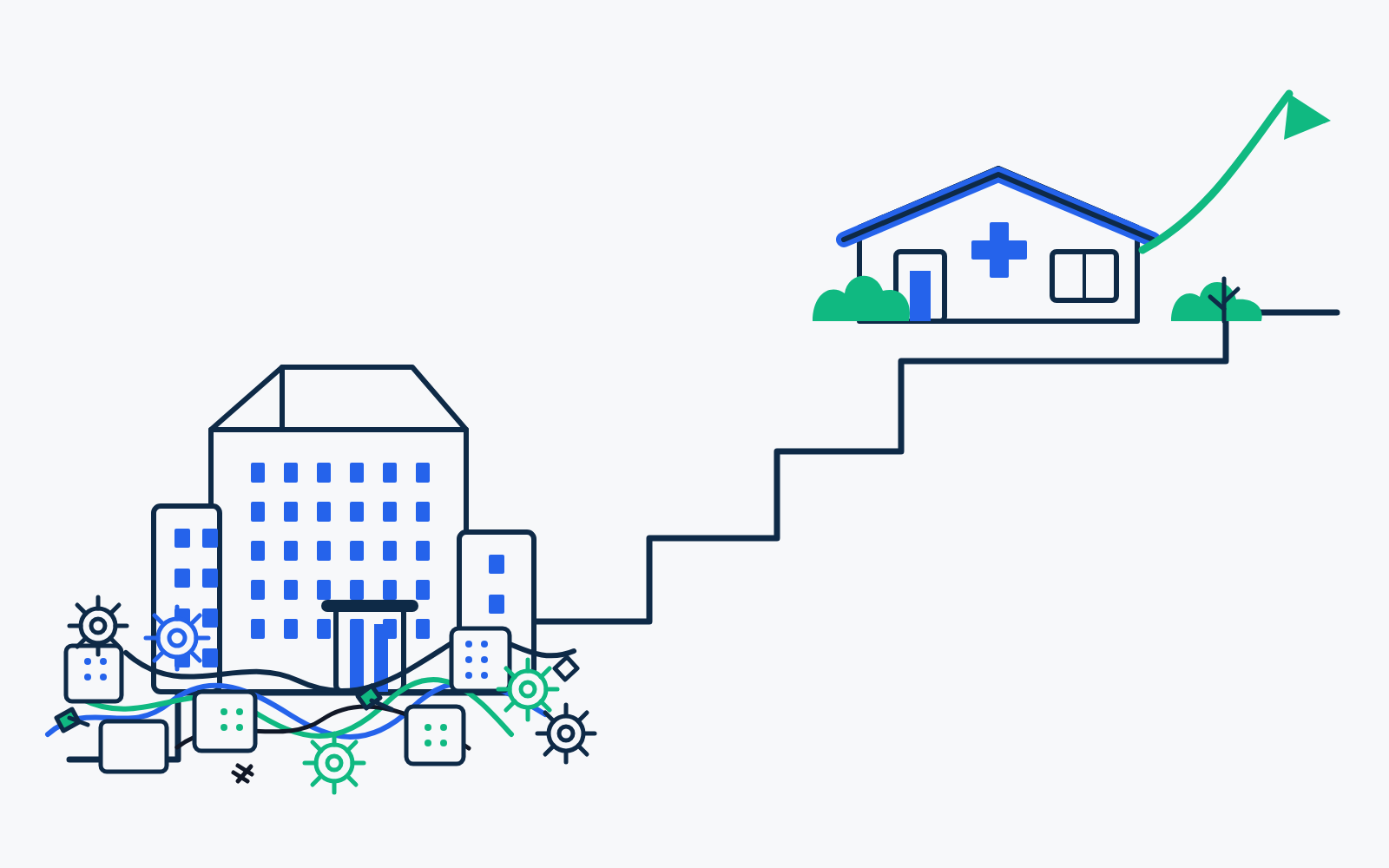
The conventional wisdom is that the organizations with the biggest AI budgets will become AI-native first — the health systems and national payers with the data science teams and the innovation offices. The two-provider practice down the street is treated as an afterthought: too small, too under-resourced, too far behind.
I think the opposite is more likely. On the Healthcare AI Maturity Model, I’d bet on the independent practice to reach Stage 4 — AI-Native — before the health system does. Not despite being small. Because it’s small.
It’s the most counterintuitive case the framework produces, which is exactly why it’s worth working through. A theory is only interesting when it predicts something surprising — and this is a genuinely surprising prediction.
The bottleneck decides the race
Start from the single most important thing the framework establishes: the barrier to becoming AI-native is not capability. Capability is a commodity — every organization, large or small, can rent state-of-the-art AI through a vendor this afternoon. The binding constraint is deployment: the organizational work of connecting the pieces, drawing the human decision boundary, and redesigning how work happens.
If the race were about capability or budget, the big organizations would win it walking away. But it isn’t. It’s about who can redesign their operation fastest — and that reframes the whole contest, because organizational agility, not organizational size, is the thing that matters. So the real question isn’t “who has the most AI?” It’s “who has the least drag?”
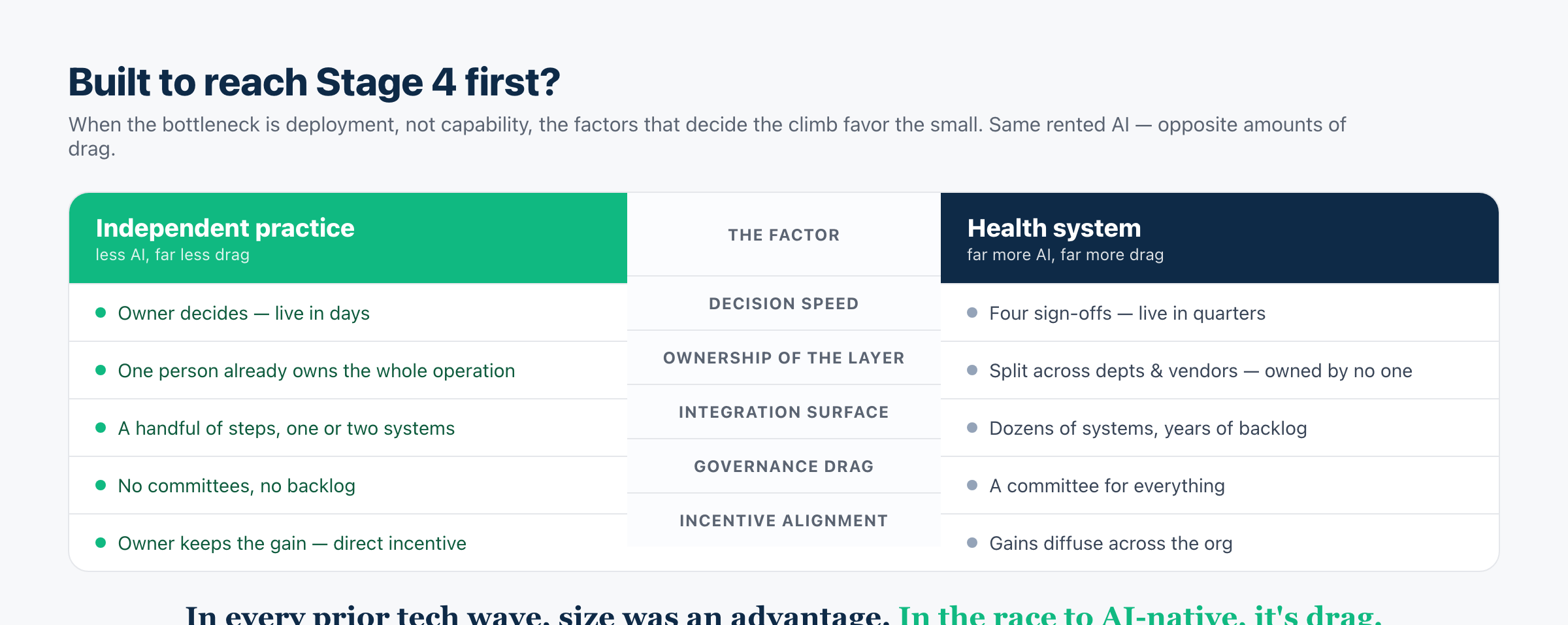
Line up the factors that actually govern the climb, and the independent practice wins nearly all of them.
Decision speed
In an independent practice, the person who decides is the person who owns the outcome, and they’re in the building. The owner can look at the front office on Monday, decide to change how it works, and have it running by the following week. There is no business case to circulate, no steering committee, no quarterly planning cycle.
A health system moves at the speed of its slowest sign-off. The same change — rethinking how the operating layer works — needs buy-in from IT, clinical leadership, compliance, and finance, each on its own calendar. What takes a practice days takes a system quarters. Over a multi-year transformation, that compounding difference in decision speed is enormous.
Ownership is already solved
I’ve argued that most organizations plateau because no one owns the operating layer — it’s split across departments and vendors, so no one drives the climb. That problem, which paralyzes large organizations, barely exists in a small practice. The owner or office manager already owns the entire operation: the phone, the schedule, the follow-up, the billing relationship. The single hardest organizational prerequisite for reaching Stage 4 — a person accountable for the whole operating layer — comes free.
Small integration surface
An independent practice’s operating layer is a handful of steps running on one or two systems. Connecting them into something coherent is a project you can actually finish. A health system’s operating layer sprawls across dozens of systems accreted over decades, with an integration backlog measured in years. The architectural work the framework asks for — making the pieces connect — is achievable at small scale and a multi-year program at large scale. And the smaller the surface, the less room for AI Sprawl to take hold in the first place.
Aligned incentives
When a small-practice owner improves the operation, they personally capture the gain — every recovered call and booked appointment shows up in a P&L they own. The incentive to push the change through is direct and immediate. In a large organization, the benefit of modernizing the operating layer is diffuse: it accrues to the institution, spread across departments, while the effort and risk fall on whoever championed it. Diffuse benefit and concentrated cost is a recipe for things not happening.
The obvious objection — and why it’s now wrong
Here’s the fair pushback: small practices have been laggards in every prior technology wave. They were last to adopt EHRs, last to digitize, last to get on modern payment systems — precisely because they lacked the capital and the IT muscle. Why would AI be different?
Because the thing that made them laggards has been priced out of the equation. Adopting an EHR meant buying and running software — servers, integrations, an IT department the practice couldn’t afford. Reaching AI-native doesn’t. The capability is now rented, not built; it arrives as a vendor subscription, no IT department required. What’s left is the organizational work — deciding, owning, connecting, redesigning — and that was always the small practice’s strength, not its weakness.
So the two things that determined the last wave have flipped. The disadvantage (no IT muscle) no longer applies, because capability is a service now. And the advantage (agility, unified ownership, aligned incentives) matters more than ever, because organizational redesign is the whole game. In every prior technology wave, size was an advantage. In the race to AI-native, it’s drag.
What would actually stop them
None of this is automatic. A small practice can still fail to become AI-native, and most will — but for a specific, fixable reason, not a structural one. The failure mode is the same plateau as everyone else’s: buying disconnected tools instead of building an architecture, dazzled by demos, never naming the owner (even when the owner is standing right there). The difference is that for a small practice, every one of those is a decision it can reverse next week, not a structural condition it’s trapped in.
The practices that win won’t be the ones that spend the most on AI. They’ll be the ones whose owner recognized that the climb was theirs to make, treated the front office as a system worth designing, and moved — while the health system down the road was still scheduling the kickoff meeting.
The bottom line
The conventional wisdom that big organizations lead technological change was true when technology meant capital and infrastructure. AI inverts it. When capability is rented and the real work is organizational redesign, the advantage shifts to whoever can decide and act fastest — and nobody decides and acts faster than a practice where the owner runs the operation and keeps the gain.
The dark horse in healthcare’s AI-native race isn’t the system with the biggest AI budget. It’s the independent practice that stops waiting to be told it’s behind, and realizes it may be the best-positioned organization in healthcare to get this right.
Frequently asked questions
Why would a small practice reach AI-Native before a large health system?
Because becoming AI-native is bottlenecked by deployment — the organizational work of connecting systems, drawing the human decision boundary, and redesigning workflows — not by AI capability, which everyone can rent equally. Small practices have decisive advantages on deployment: fast decisions, a single owner of the whole operation, a small integration surface, and directly aligned incentives. Health systems have more AI but far more organizational drag.
Aren’t small practices always behind on technology?
They were, in every prior wave — because adopting technology meant buying and running infrastructure they couldn’t afford. AI changes the equation: capability now arrives as a vendor subscription, with no IT department required. What’s left is organizational redesign, which is the small practice’s strength. The old disadvantage no longer applies; the old advantage matters more.
What’s stopping most small practices, then?
The same plateau that traps everyone: buying disconnected tools instead of an architecture, optimizing for demos, and never explicitly naming an owner for the operating layer. The difference is that at small scale each of these is a decision reversible next week, not a structural condition — so the barrier is choice, not capacity.
Does this mean health systems can’t become AI-native?
They can, but it’s harder and slower, because their advantages (budget, talent) aren’t the binding constraint and their disadvantages (governance drag, split ownership, integration backlogs) are. A health system’s path runs through naming an owner for the operating layer and sequencing operations before clinical AI — the same moves, against much more organizational resistance.
What should an independent practice do first?
Start with the front office — the highest-volume, most measurable, most deployable part of the operation. Name the owner explicitly (usually the practice owner or manager), connect the pieces so they share context and write back, and define where AI acts versus where it escalates to a person. Small scale makes all of this achievable in weeks, not quarters.
Read next
- The Healthcare AI Maturity Model
- Capability Doesn’t Matter If You Can’t Deploy It
- Who Owns the Operating Layer?
- Why Organizations Plateau at AI-Assisted
- The AI Front Office