If you’ve read this far in the series, you have the map. You know healthcare becomes AI-native from the operations up. You know the four stages an organization climbs. You know that at the top, humans decide and AI operates.
So here is the question I get from every executive once they see the ladder: if the path is that clear, why doesn’t everyone just climb it?
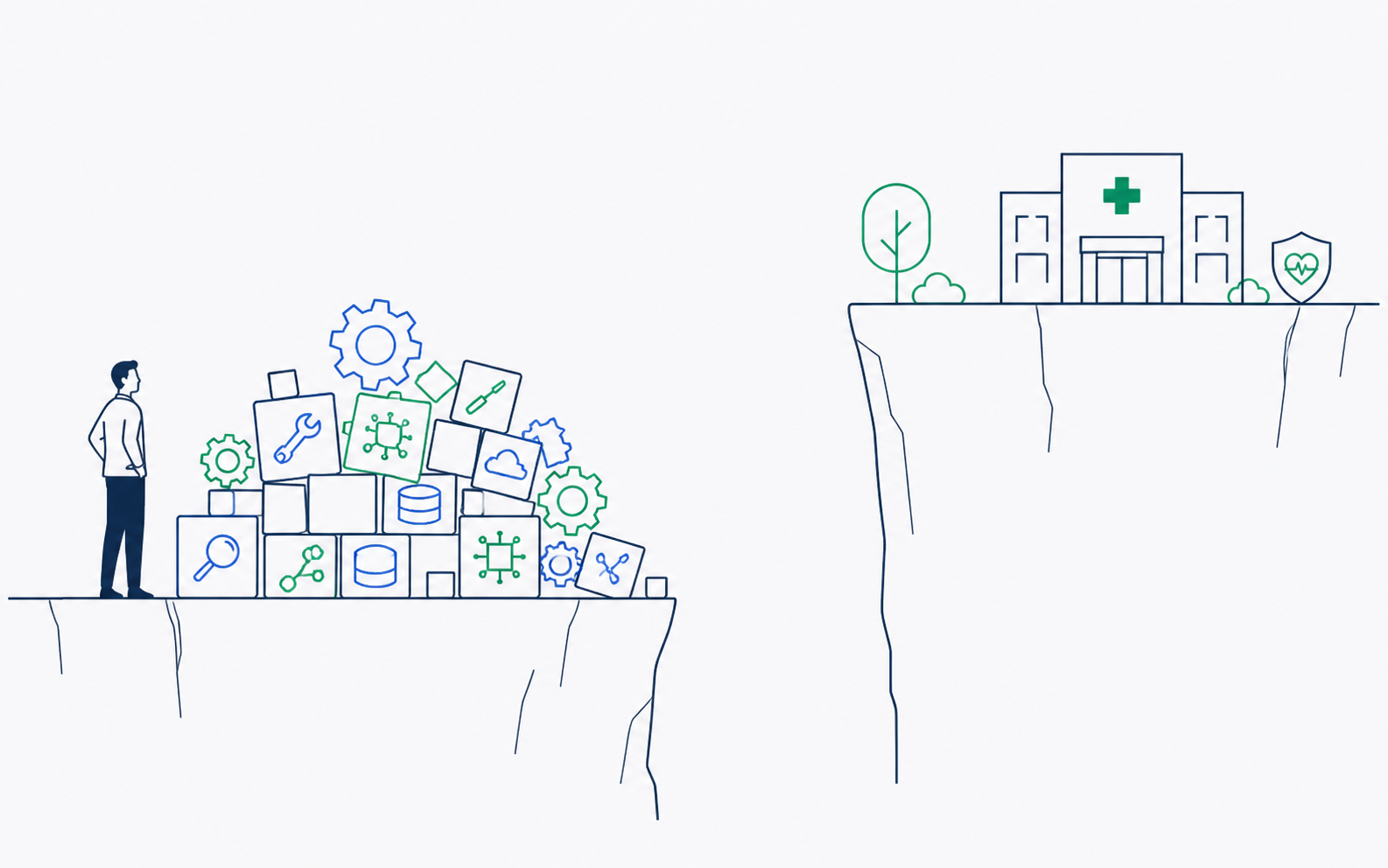
They don’t, and most never will. Not because the technology isn’t ready — it is. Organizations get stuck, and they almost all get stuck in the same place: Stage 3, AI-Assisted. The plateau. They have AI. They have, if anything, too much of it. And they are no closer to being AI-native than they were before they bought any of it.
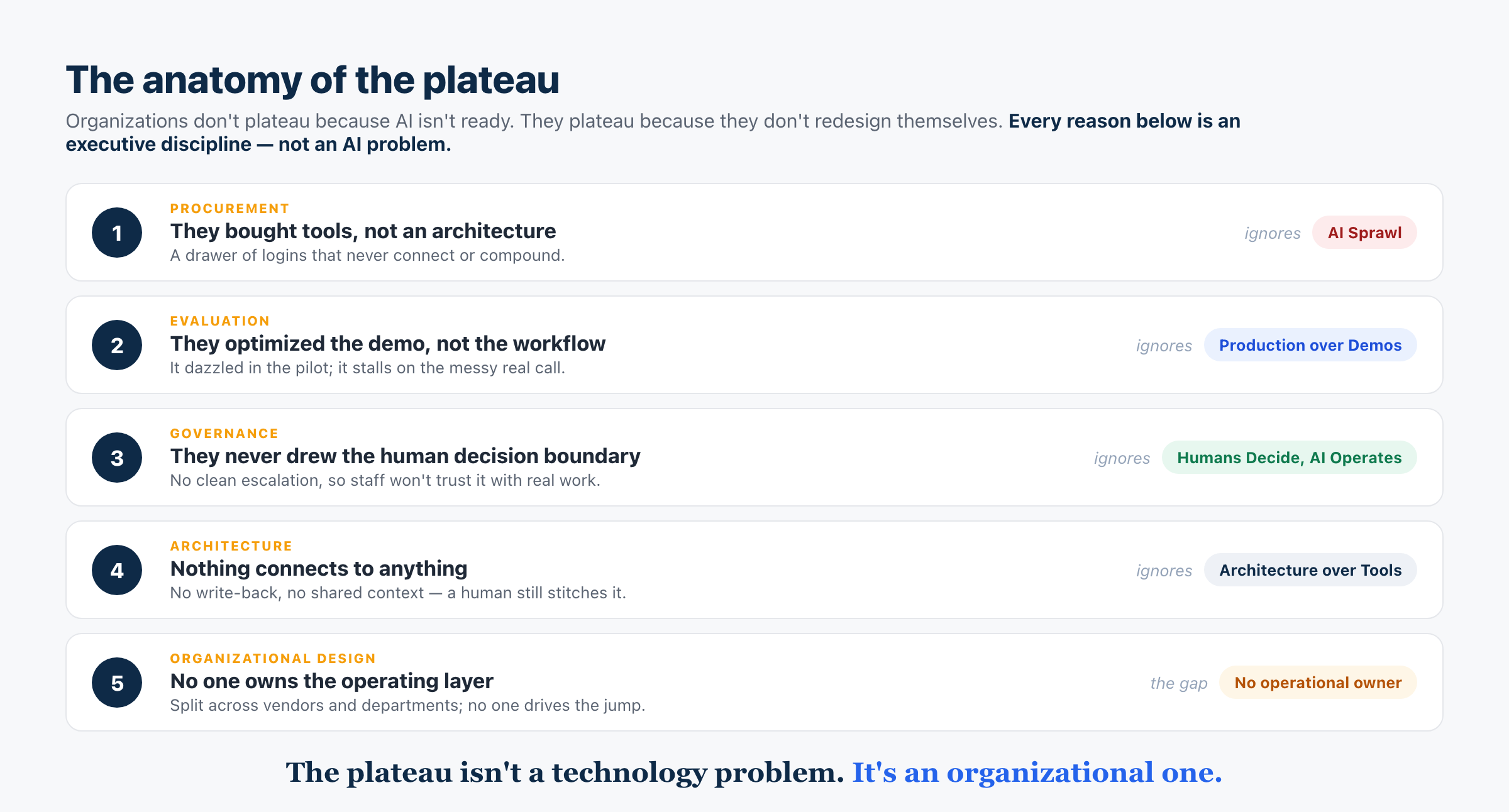
I’ve watched this happen enough times to be confident about the cause. Organizations don’t plateau because AI isn’t ready — it is. They plateau because they don’t redesign themselves. The plateau is where organizations stop, not where AI fails. Here are the five reasons they get stuck — and every one, you’ll notice, is a decision an executive didn’t make, not a limit of the technology.
1. They bought tools, not an architecture
This is the big one, and it’s the one I named AI Sprawl: a drawer full of AI logins that each do one thing and never connect. A scribe here, a scheduling bot there, a chat widget, a recall texter. Every purchase felt like progress. None of them compound.
Stage 3 is where AI Sprawl accumulates, because buying a tool is easy and building an architecture is not. Adding a tenth assistant doesn’t move you toward Stage 4 — it just deepens the pile. You cannot buy your way off the plateau, because the thing you’re missing was never for sale. Architecture isn’t a product; it’s a set of decisions about how the pieces fit.
2. They optimized the demo, not the workflow
Every tool that got bought won a demo. It sounded great in a controlled thirty-minute pitch. Then it met a real patient on a bad connection, switching languages mid-sentence, correcting a wrong phone number, asking about a bill and a symptom in the same breath — and it quietly fell short.
This is the difference between capability and deployment, and it’s why Production over Demos is a principle and not a slogan. A demo shows what a system can do on its best day; the plateau is full of organizations that bought best-day performance and got average-day reality. The gap between the two is where trust dies — and once staff stop trusting a tool, they route around it, and it becomes shelfware that still shows up on the invoice.
3. They never drew the human decision boundary
Here’s a subtle one that stalls more organizations than people realize. For staff to actually hand real work to an AI system, they have to trust what it will do when something goes wrong — when a caller is urgent, angry, or clinical. If there’s no clean, designed boundary for when the AI acts versus when it escalates to a person, staff can’t trust it, so they only let it handle the trivial stuff.
That’s the plateau in miniature: an AI that’s allowed to do the easy 20% because no one defined how it hands off the hard 20%. As I argued in Humans Decide. AI Operates., escalation is a first-class feature, not a fallback. Skip that design work and the system never earns enough trust to carry real volume — so it stays an assistant forever.
4. Nothing connects to anything
At Stage 3, the AI can talk but it can’t act inside the practice. It captures a message a human re-keys. It answers a question but can’t write the booking into the schedule. It has no shared memory across channels, so the patient who called Monday and texts Tuesday starts over.
This is Architecture over Tools stated as a failure. When nothing connects, a human is still standing in the middle stitching the pieces together by hand — which means you’ve automated the talking and left the working. The organization has more AI and the same overloaded staff. Integration is unglamorous and hard, and it is precisely the work that separates Stage 3 from Stage 4.
5. No one owns the operating layer
This is the reason executives least expect and most need to hear. In most organizations, the operational layer isn’t owned by anyone. The phone system belongs to one vendor, scheduling to another, the website to marketing, billing to the RCM team, the new AI tool to whoever ran the pilot. No single person is accountable for how a patient moves through the whole operation — so no single person is driving the climb to Stage 4.
Architecture requires an owner. Someone has to decide how the layers connect, where the human boundary sits, what gets built in what order. Without that owner, every tool is somebody’s side project and the operating layer as a whole is nobody’s job. Organizations don’t plateau because they lack AI talent. They plateau because no one has the mandate to redesign how work happens.
The pattern
Look back at the five and the shape is unmistakable. Not one of them is “the models aren’t good enough.” Look closer and something sharper emerges: not one of them is an AI problem at all. Buying tools instead of architecture is a procurement failure. Optimizing for the demo is an evaluation failure. No decision boundary is a governance failure. Nothing connecting is an architecture failure. No owner is a failure of organizational design. These are executive functions, every one — which means the plateau is not something a vendor put you on, and not something a vendor can get you off.
This is the larger truth the plateau reveals: AI transformation is an organizational transformation problem, not a technology problem. The technology is ready and getting readier by the month. What isn’t ready is the organization — its procurement habits, its evaluation standards, its governance, its architecture, its ownership. That’s why more technology is not the answer, and why the vendors promising to sell you Stage 4 are selling something that doesn’t exist. The plateau is where organizations stop, not where AI fails. Getting off it isn’t a purchase — it’s a decision to treat the operational layer as a system worth designing, and to give someone the job of designing it.
Which is also the good news. If the barrier were the technology, you’d be waiting on OpenAI or Google. It isn’t, so you’re not. The organizations that break out of Stage 3 won’t be the ones with the biggest AI budgets — they’ll be the ones that understood the climb was theirs to make.
Because the difference between Stage 3 and Stage 4 isn’t another AI purchase. It’s an organizational redesign. Stage 4 isn’t something you buy. It’s something you become.
Frequently asked questions
What is the “AI-Assisted plateau”?
It’s Stage 3 of the Healthcare AI Maturity Model — the stage where an organization has adopted AI to help with individual tasks but a human still stitches the workflow together, and where most organizations get stuck. It feels like progress (you have AI now) while quietly stalling, because accumulating more tools doesn’t advance you toward being AI-native.
Why do most organizations get stuck at AI-Assisted?
For five organizational reasons, not technological ones: they bought disconnected tools instead of an architecture (AI Sprawl), optimized for demos instead of production reality, never designed the human decision boundary, never connected their systems, and — most overlooked — no one owns the operating layer as a whole. Each is a decision the organization failed to make, not a limit of the AI.
If the technology is ready, why is the jump so hard?
Because the jump from Stage 3 to Stage 4 is architectural, not technological. It requires connecting tools into a system, defining where AI acts versus where humans decide, and giving someone the mandate to redesign how work happens. That’s organizational change, which is harder and slower than buying software — but it’s also fully within the organization’s control.
How do you get off the plateau?
Stop buying tools and start building an architecture: put a single owner in charge of the operating layer, connect the pieces so they write back and share context, define the human decision boundary explicitly, and hold new capabilities to production reality rather than demo performance. Begin with the highest-volume operational layer — usually the front office.
Isn’t buying best-of-breed AI tools a reasonable strategy?
Good tools help only if they’re part of an architecture. Without one, best-of-breed becomes AI Sprawl — a collection of strong point solutions that don’t connect, don’t compound, and leave staff doing the integration by hand. The test isn’t how capable each tool is; it’s whether they add up to a system.
Read next
- The Healthcare AI Maturity Model
- Why Healthcare Needs an AI Architecture (Not More AI Tools)
- Humans Decide. AI Operates.
- The AI Front Office
- AI Voice Agent Architecture: What I Learned Building the Same Agent Three Times